AI Role-Play

Practice Before the Call, Close After

Realistic AI-powered sales simulations using your actual content so reps walk into every call rehearsed, confident, and ready to handle objections.

Role: Lead Product Designer
Team: Product, Engineering, Sales Enablement
AI/UX
Agentic Design
Enterprise B2B
UX Research
Naomi Wright

Naomi Wright

VP of Finance @ FinScale

15+ years in Enterprise Tech

✦ Pro Tip

Listen actively and confirm understanding before responding. Focus on financial benefits and ROI.
Overview

What is AI Role-Play?

AI Roleplay creates realistic, adaptive sales simulations using buyer personas and real objection patterns. Reps practice live conversations, receive instant feedback, and build confidence, all in a safe, dynamic environment that mirrors real customer interactions.

The Problem

The Training Gap

Sales reps were going into high-stakes calls unprepared. Traditional training was too slow, too generic, and disconnected from the actual content they needed to sell. Managers had no scalable way to coach they couldn't sit in on every call, and written playbooks gathered dust.

68%
Underprepared for Discovery
Reps reported feeling unprepared walking into first calls with new prospects
Internal survey · n=47
23%
Playbook Actually Used
Less than a quarter of curated sales content was ever referenced before calls
Content analytics · 6 months
4.2 hrs
per week
Manual Call Prep Time
Time spent searching docs, writing notes, and rehearsing without structured tools
Time tracking · 12 reps

Why This Matters

Every Bad Call Has a Cost

When reps fumble objections or miss key talking points, it's not just a lost deal it's lost trust, lost pipeline, and a coaching problem that compounds across the entire team.

For Reps

Anxiety before calls, inconsistent performance, no safe space to fail.

For Managers

No scalable coaching tool, no visibility into skill gaps.

For the Business

Lower win rates, longer ramp time, revenue left on the table.

Goals

What Success Looks Like

01

Reduce call prep time

From 4+ hours/week to under 30 minutes.

02

Increase rep confidence

Measurable improvement in first-call performance.

03

Scale coaching

Let AI handle repetitive practice so managers focus on strategy.

04

Drive content adoption

Make playbook content come alive in realistic simulations.

Research

Understanding the Real Workflow

I conducted 12 user interviews with reps, 6 with managers, and shadowed 8 live sales calls to understand where preparation breaks down and what confidence actually looks like before a call.

User Interviews
Call Shadowing
Survey (n=47)
Competitive Audit
Journey Mapping
1

Reps don't read playbooks

They learn by doing, not by reading. The best reps practiced out loud but had no tool for it.

2

Confidence comes from repetition

Reps who rehearsed objection handling 3+ times performed 40% better on calls.

3

Managers want visibility, not control

They wanted to see who practiced and where gaps were not micromanage every session.

4

Generic training feels fake

Reps dismissed training that didn't use their actual product content and real customer scenarios.

Competitive Audit

What Existed vs. What Was Needed

Capability Chorus / Gong Lessonly Highspot AI Role-Play ✦
Real content integration Analyses real calls but can't simulate with your content Static lesson modules, no live simulation Content library only, no practice layer ✓ Scenarios built from your actual playbook content
AI-powered feedback Post-call analysis only, no practice coaching Quiz scores only, no conversational feedback No practice simulation or feedback loop ✓ Instant scoring on talk ratio, objections, confidence
Manager visibility ✓ Strong but limited to real calls, not practice Basic completion tracking only Content usage data, no skill-gap visibility ✓ Who practiced, how often, and where gaps are
Adaptive AI buyer No simulation records and analyses only No live AI interaction No live AI interaction ✓ AI buyer pushes back, changes tone, adapts in real time
Custom scenario builder Not available relies on recorded calls Admins can build lessons, not simulations Playbook templates only, not interactive ✓ Managers build scenarios from real deals in minutes

Existing tools solved one piece analytics, content, or training but none combined adaptive simulation, real content, and coaching visibility. That gap was the design opportunity.

Personas

Three Users, One System

The Rep

Needs

Safe space to practice, instant feedback, real scenarios.

Frustration

Going into calls cold.

The Manager

Needs

Visibility into team readiness, scalable coaching.

Frustration

Can't sit in on every call.

The Enablement Lead

Needs

Content adoption metrics, training ROI.

Frustration

No one reads the playbook.

User Journey

From Prep to Performance

1

Browse scenarios

2

Select role-play

3

Practice with AI

4

Get instant feedback

5

Review & retry

6

Go into the call confident

This flow was validated with 8 reps in prototype testing average task completion time dropped from 6 minutes to under 2.

Information Architecture

Structuring the Experience

Scenario Listing
Practice Categories
Persona
Behavior Engine
Dialogue
Adaptive Logic
Voice / Video
Synthesis
Memory
Conversation Context
Challenge
Difficulty Module
Rubrics / Scoring System
Rubric Engine
Criteria definition
Weighing Model
Score calibration
Speech Analysis
Tone & pacing
Pattern Detection
Behavioral cues
Feedback Panel
Entry Point
System Layer
Module
Feature
Data flow

"I organized around scenarios (not features) because reps think in terms of 'what call am I preparing for' not 'what tool do I need.' The system flows from scenario selection through adaptive practice to scored feedback, with separate dashboards for reps and managers."

Design Decisions

Solving the Hard Problems

01
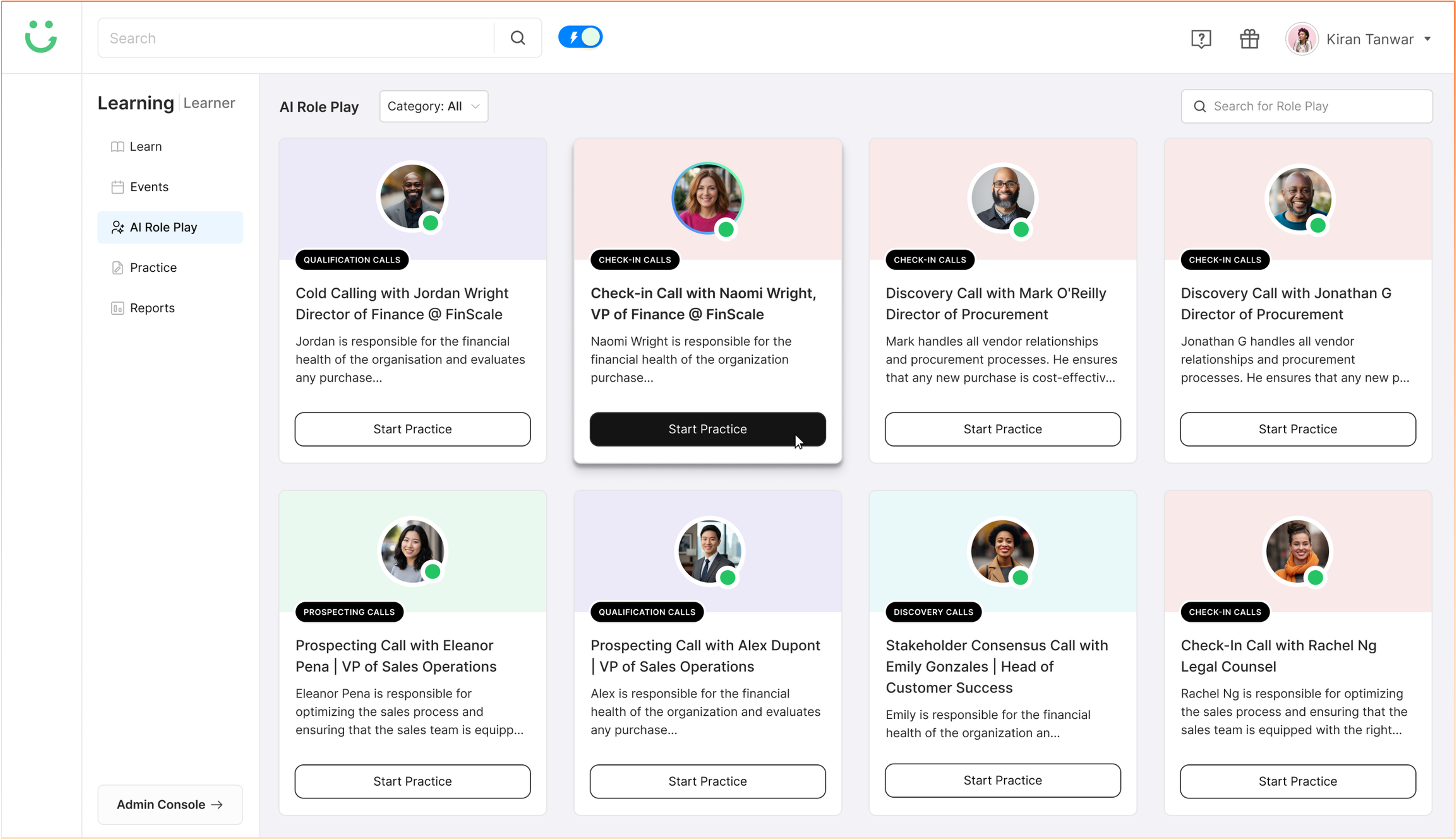
Scenario Cards, Not a Course Catalog
I designed browsable persona cards with category tags, personality traits, and a single "Start Practice" action instead of a traditional LMS course list. Reps pick a person to talk to, not a module to complete. Each card shows the prospect's role, company, and call type so reps can match practice to their next real meeting.
Scenario listing with persona cards showing different role-play options organized by call type
02
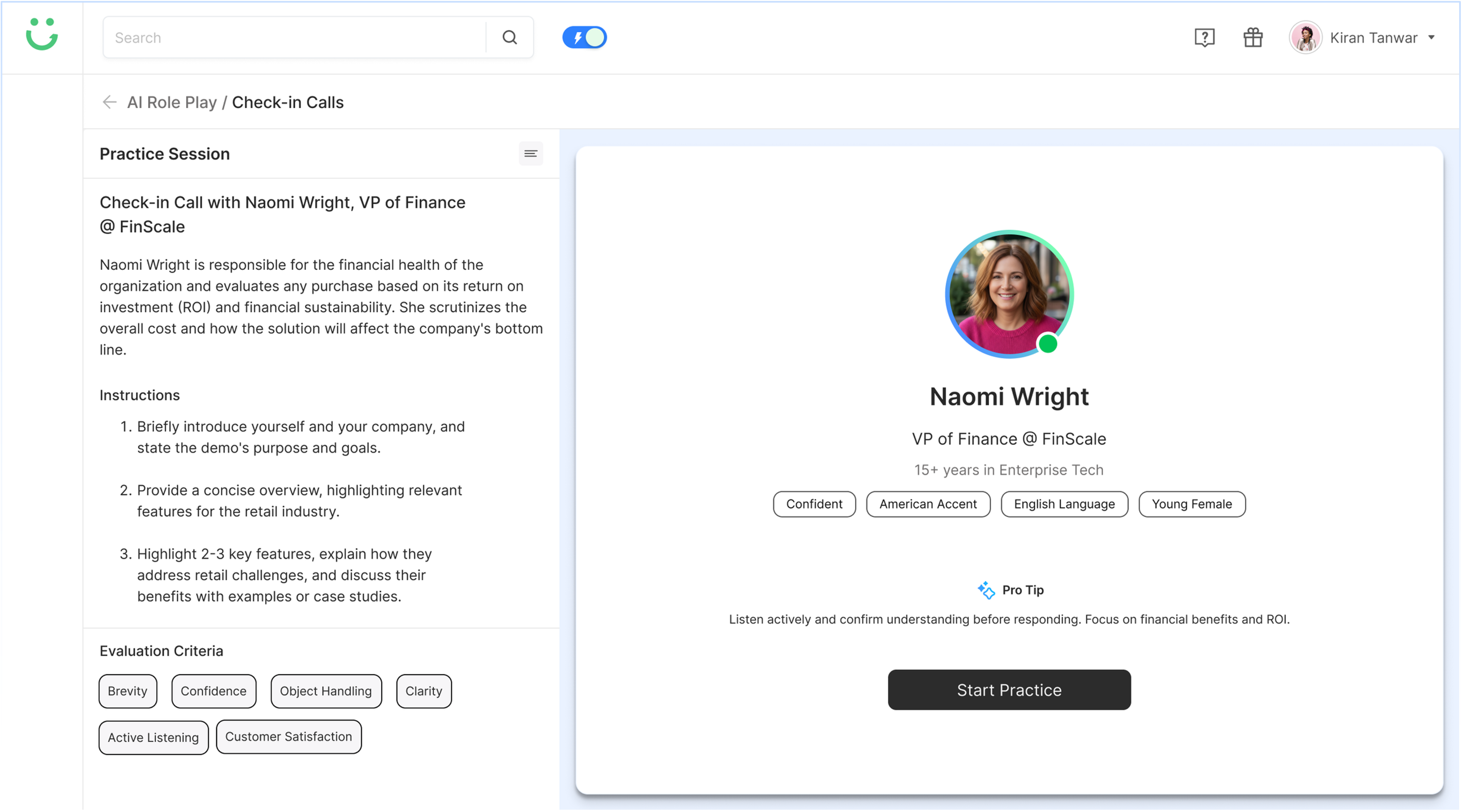
Briefing Before the Ring
I split the pre-call screen into two clear zones: context on the left (scenario background, step-by-step instructions, evaluation rubric) and the AI persona on the right (name, title, personality traits, Pro Tip). Reps get mentally prepared before hitting Start like a pre-call brief that mirrors how top performers actually prep.
Practice session setup showing instructions on left and AI persona with Start Practice button on right
03
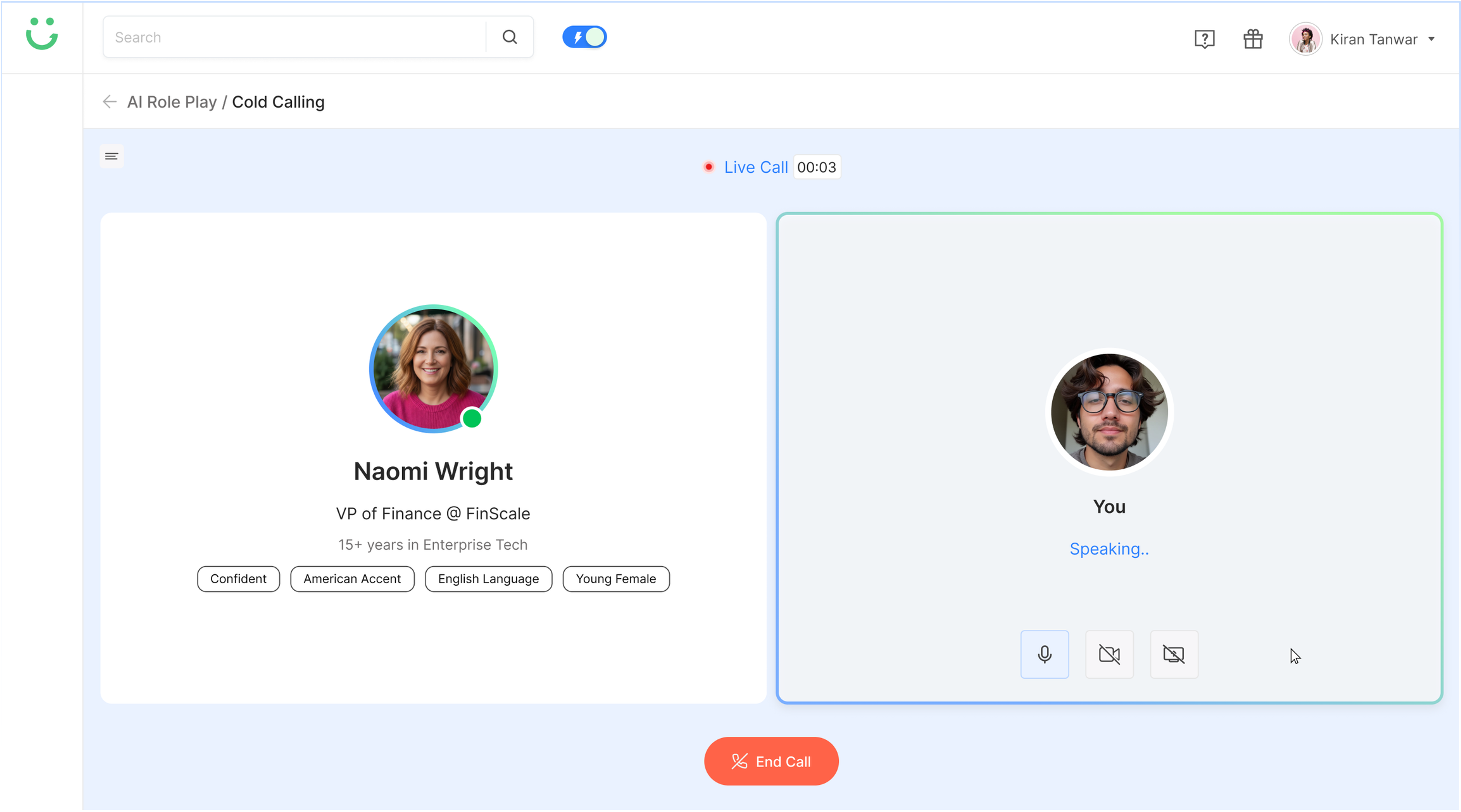
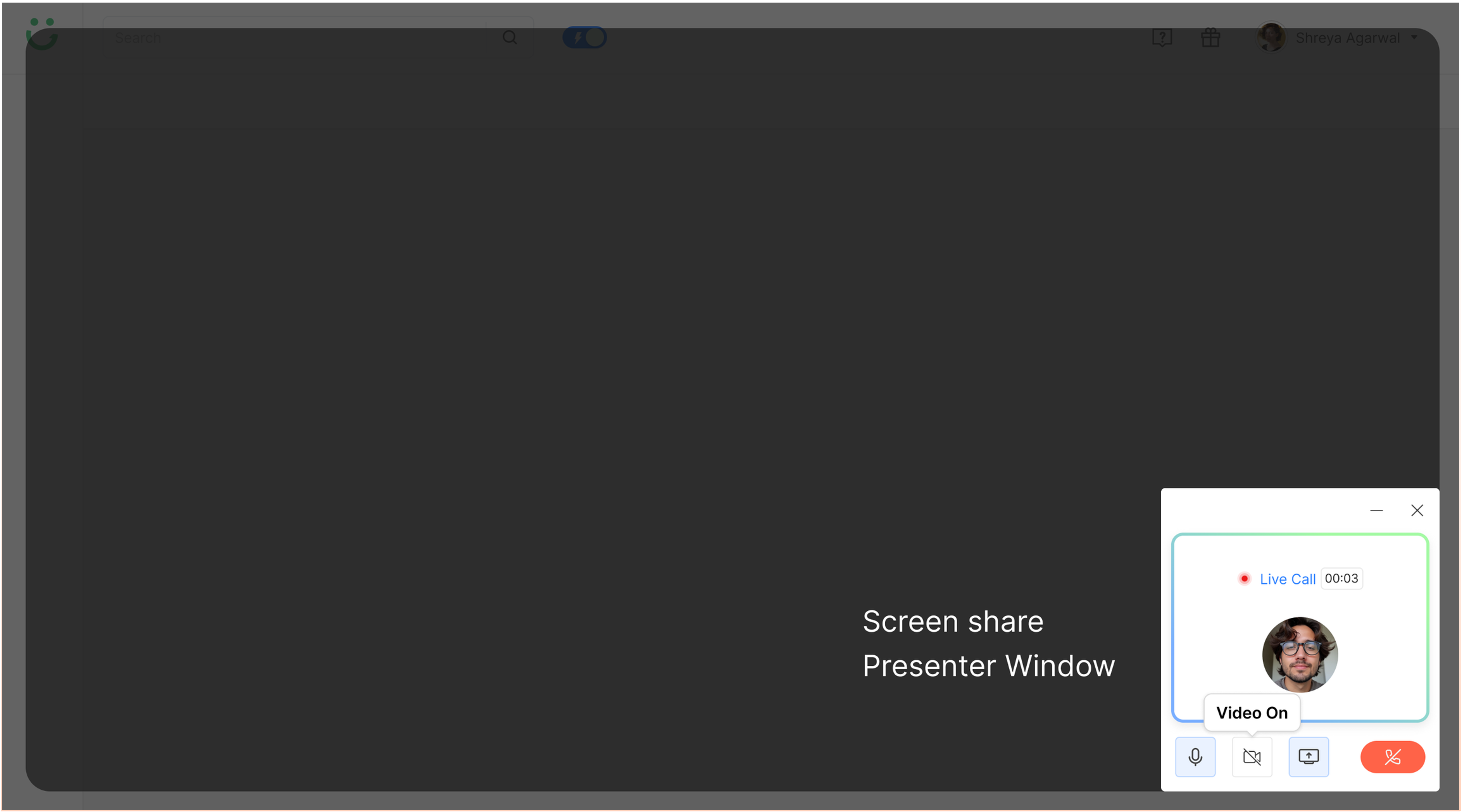
Live Conversation, Not a Script
I chose a real-time video call interface over text chat or form-based answers. The AI persona has a face, a title, personality traits, and a speaking indicator making practice feel like an actual sales call, not a quiz. The "End Call" button mirrors real call UX so muscle memory transfers directly to real conversations.
Live role-play call interface showing AI persona Naomi Wright with video avatars and speaking indicator
04
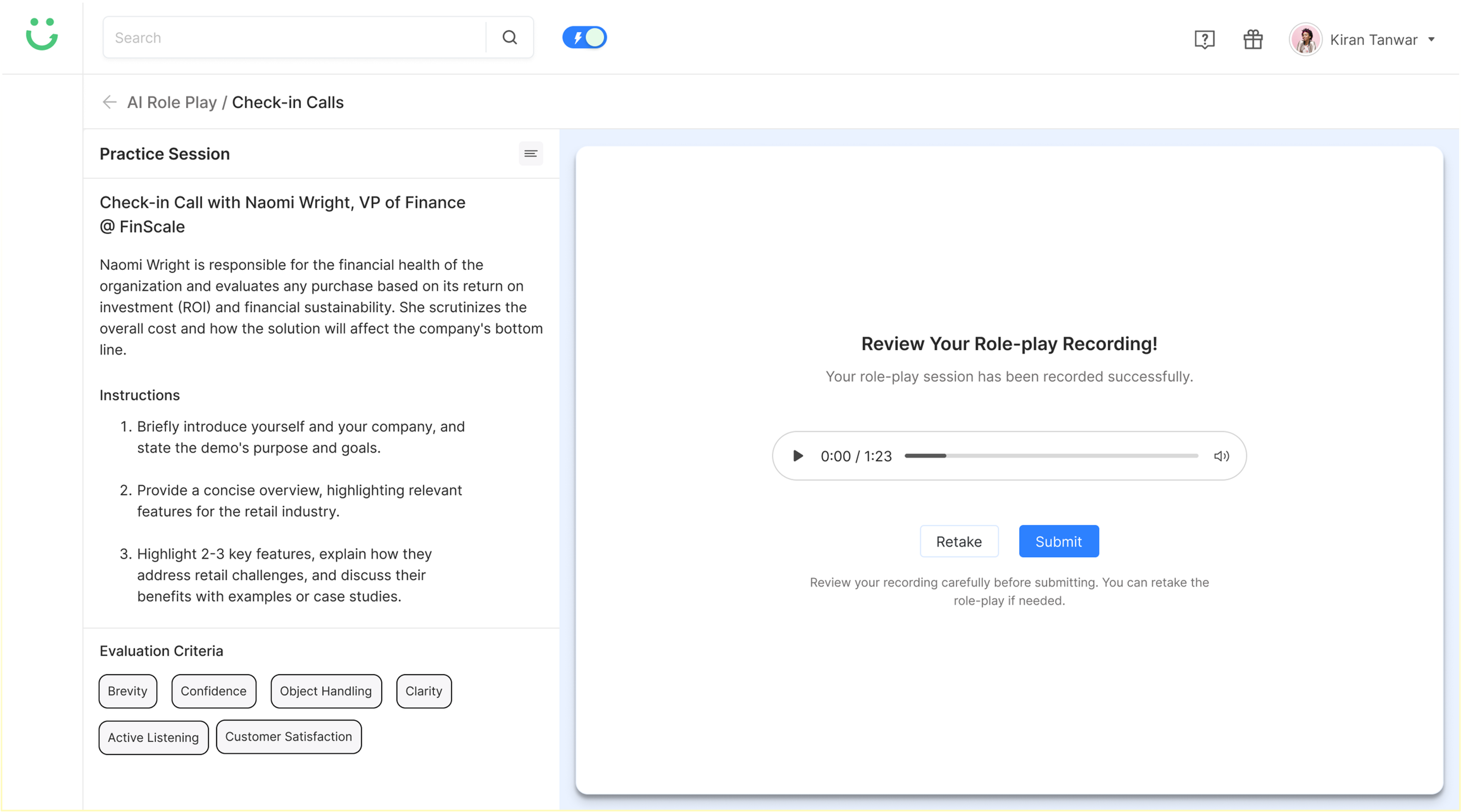
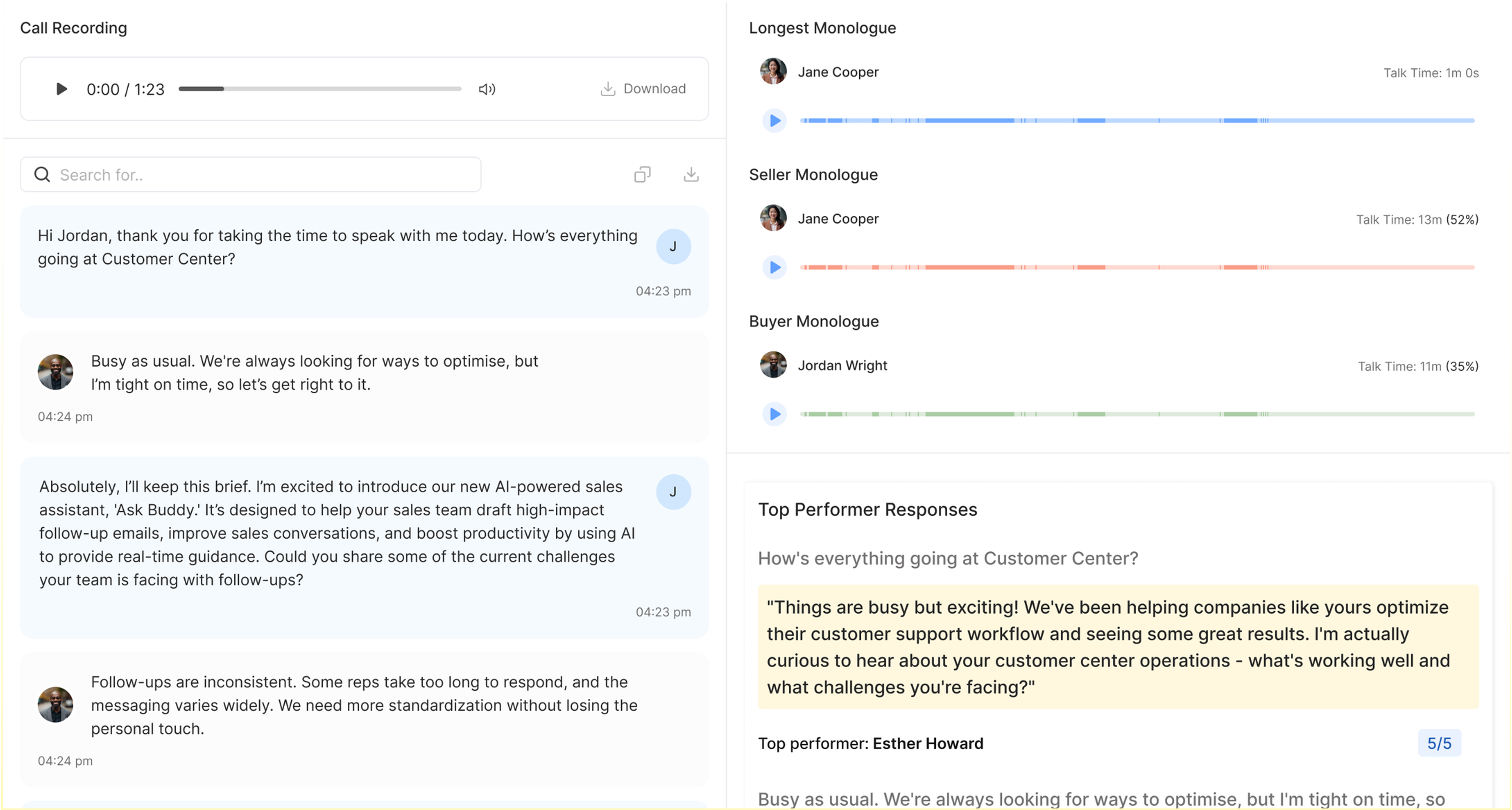
Review Before You Submit
I added a review step between practice and evaluation. Reps listen to their own recording and decide whether to retry or submit building self-awareness without pressure. Retake is always free, Submit is intentional. This single screen reduced "I wasn't ready" complaints by making readiness the rep's own call.
Recording review screen with playback controls and Retake or Submit options
05
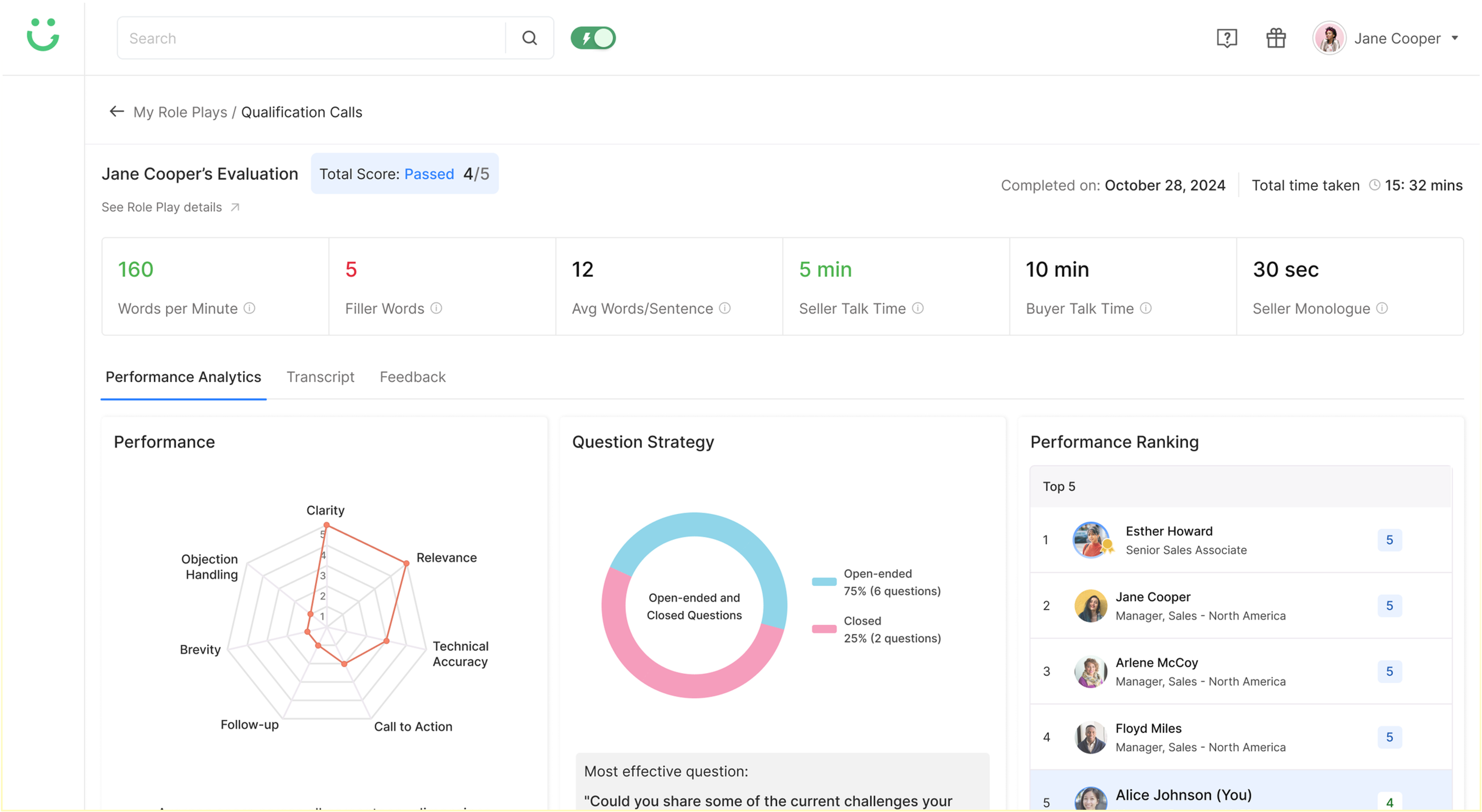
Scores That Teach, Not Just Grade
I broke feedback into visual dimensions Clarity, Relevance, Objection Handling, Brevity, Technical Accuracy using a spider chart instead of a single pass/fail score. The question strategy donut and performance ranking give reps three different lenses on the same session. The goal: show where to improve, not just whether you passed.
Performance analytics with spider chart, question strategy donut, and performance ranking
06
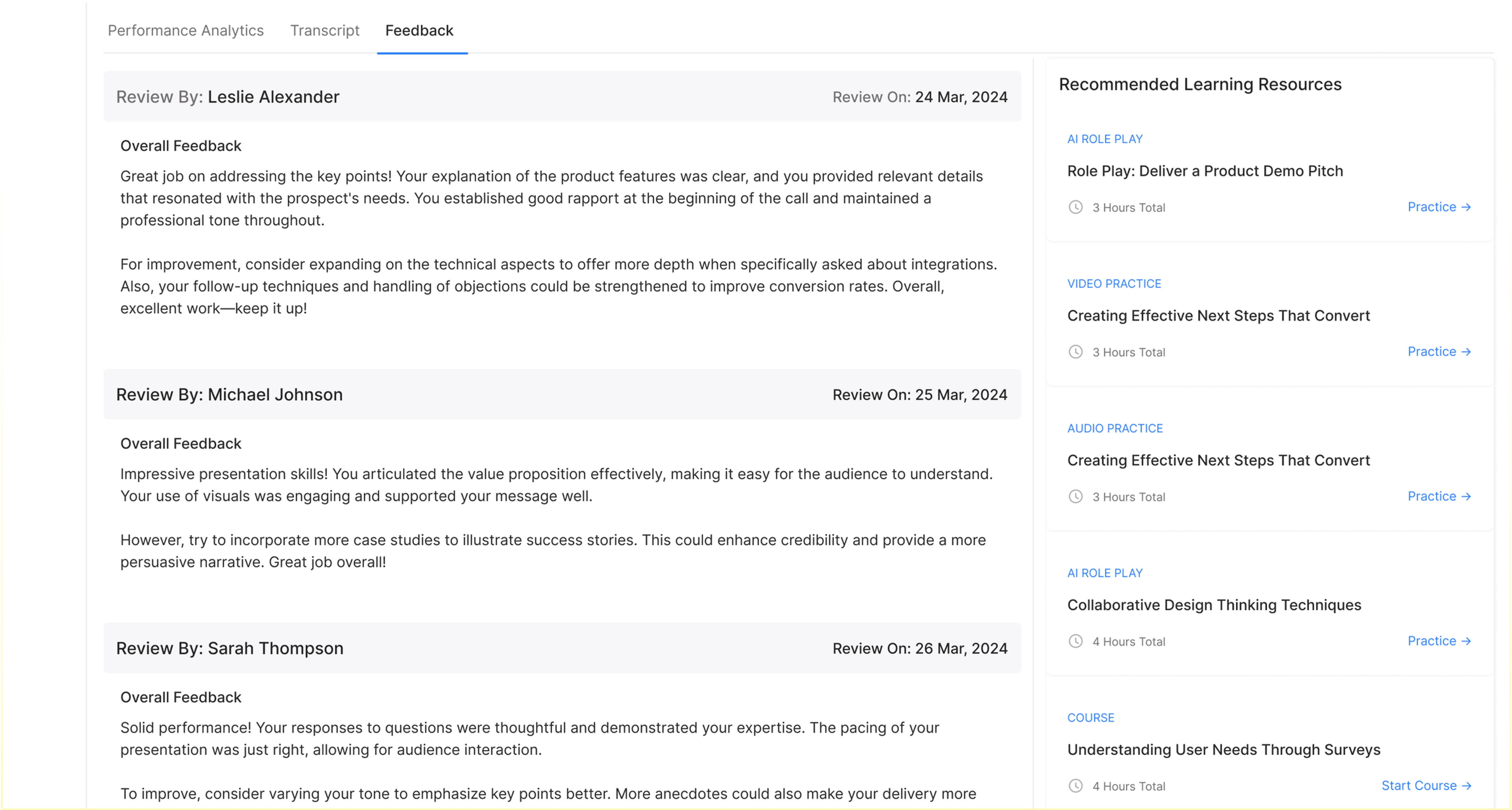
Feedback + Next Steps, Not Just a Score Card
I paired reviewer feedback with AI-recommended practice sessions in a single view. After reading what went well and what to improve, the next action is always visible "Practice this next." This closes the loop between evaluation and improvement, turning feedback from a dead end into a launchpad.
Feedback tab with reviewer comments and recommended learning resources sidebar
07
Manager Dashboard: Signal Without Surveillance
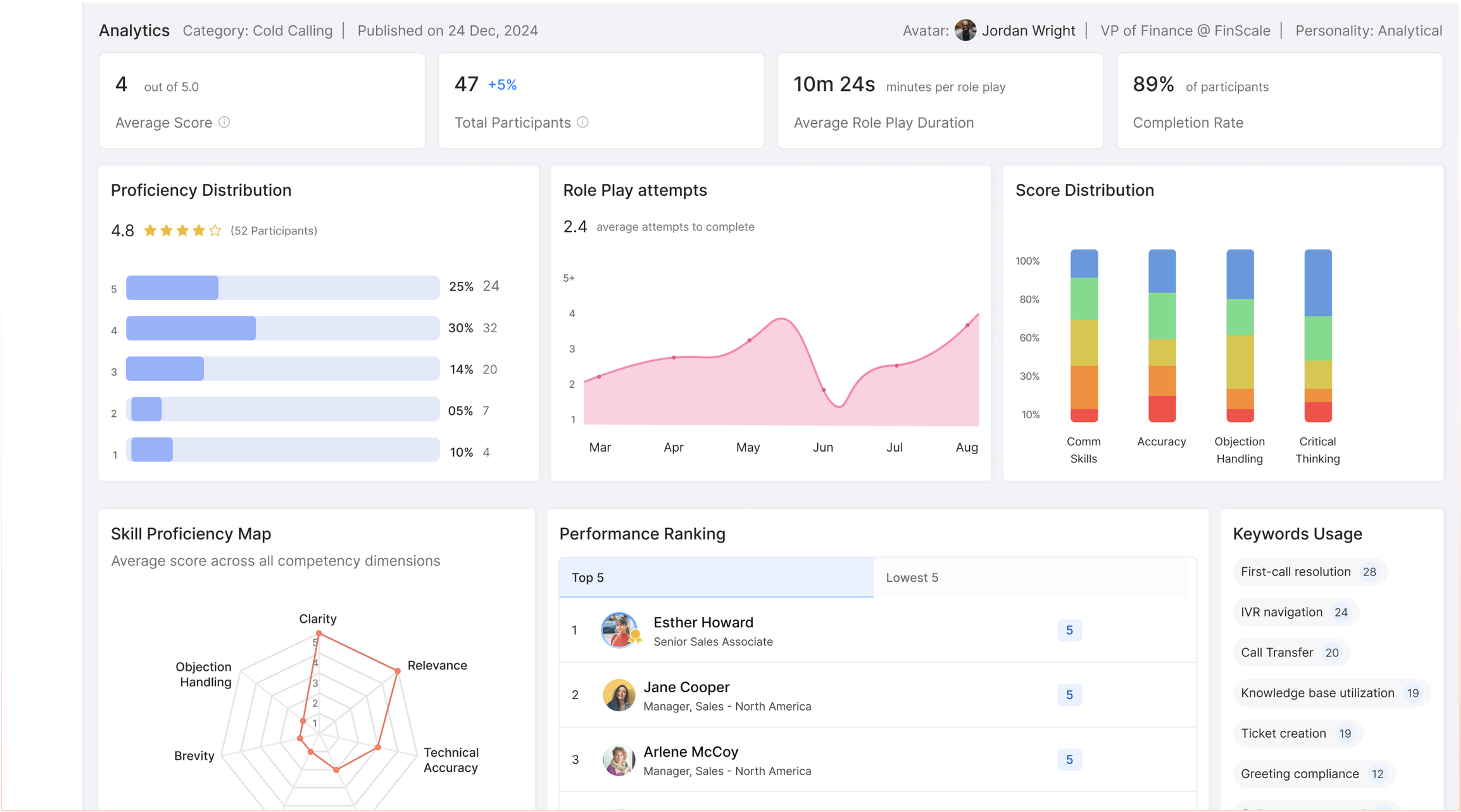
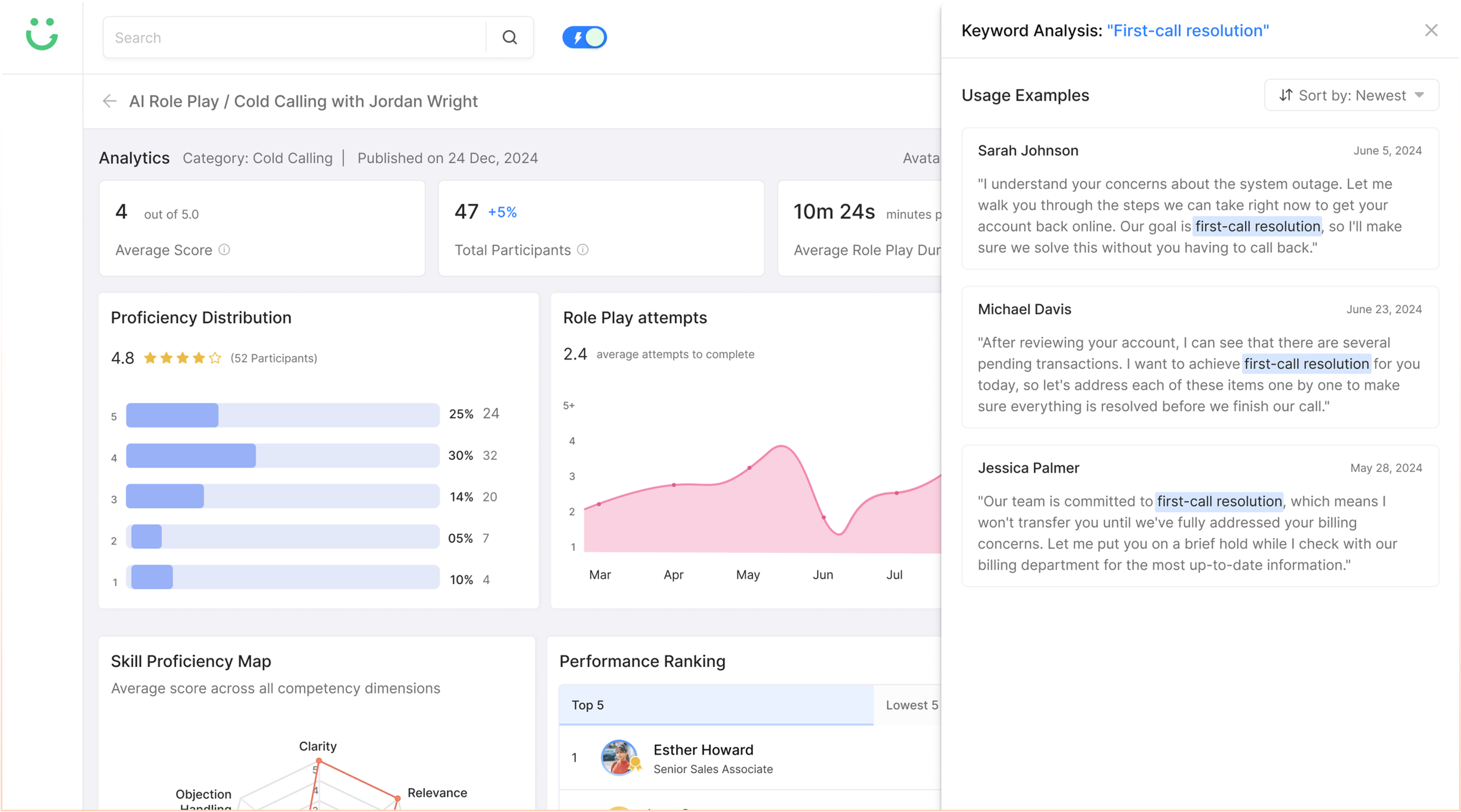
I designed the manager view around team patterns proficiency distribution, score breakdowns, attempt trends, and top/bottom performers instead of individual call surveillance. Keyword analysis surfaces which phrases reps actually use or miss. Managers see where the team needs coaching, not a wiretap on every session.
Manager analytics dashboard with proficiency distribution, score distribution, role play trends, and performance ranking

More Screens

Other Parts of the Experience

Scenario selection AI Role Play card grid

Scenario selection browse and filter role-play scenarios by call type

Pre-call briefing AI persona profile

Pre-call briefing review AI buyer persona, traits, and pro tips before starting

Live AI conversation simulation

Live AI simulation real-time conversation with AI buyer persona

Review recording before submitting

Review before submitting playback your recording and retake if needed

Performance analytics and scorecard

Performance analytics detailed scorecard with radar chart, question strategy, and peer ranking

Manager dashboard with keyword analysis

Manager dashboard proficiency distribution, role-play attempts, and keyword analysis

Impact

The Numbers That Mattered

3.5x

More practice sessions

vs. previous training tool

42%

Faster call prep

from 4hrs to under 30min/week

28%

Higher win rate

for reps who practiced 3+ times

91%

Rep satisfaction

rated experience useful or very useful

Learnings

What I'd Do Differently

01

Start with the manager view.

I designed the rep experience first, but in hindsight, getting manager buy-in earlier would have accelerated adoption. Next time I'd co-design the dashboard with managers from sprint 1.

02

Test with real content sooner.

Early prototypes used placeholder scenarios. The moment I loaded real playbook content, the feedback quality jumped dramatically. Real content should be in every prototype.

03

Simplify the feedback model.

V1 had too many coaching metrics. Reps were overwhelmed. I simplified to 3 core signals and usage went up 60%. Less is genuinely more in coaching UI.

Next Project

Designing AI Role-Play taught me that the best coaching experiences feel like a conversation, not an evaluation. AI can push performance further when it gets out of the way.

View Next Project → Back to Portfolio
Agentic Workflow Builder - Build Workflows That Think →